
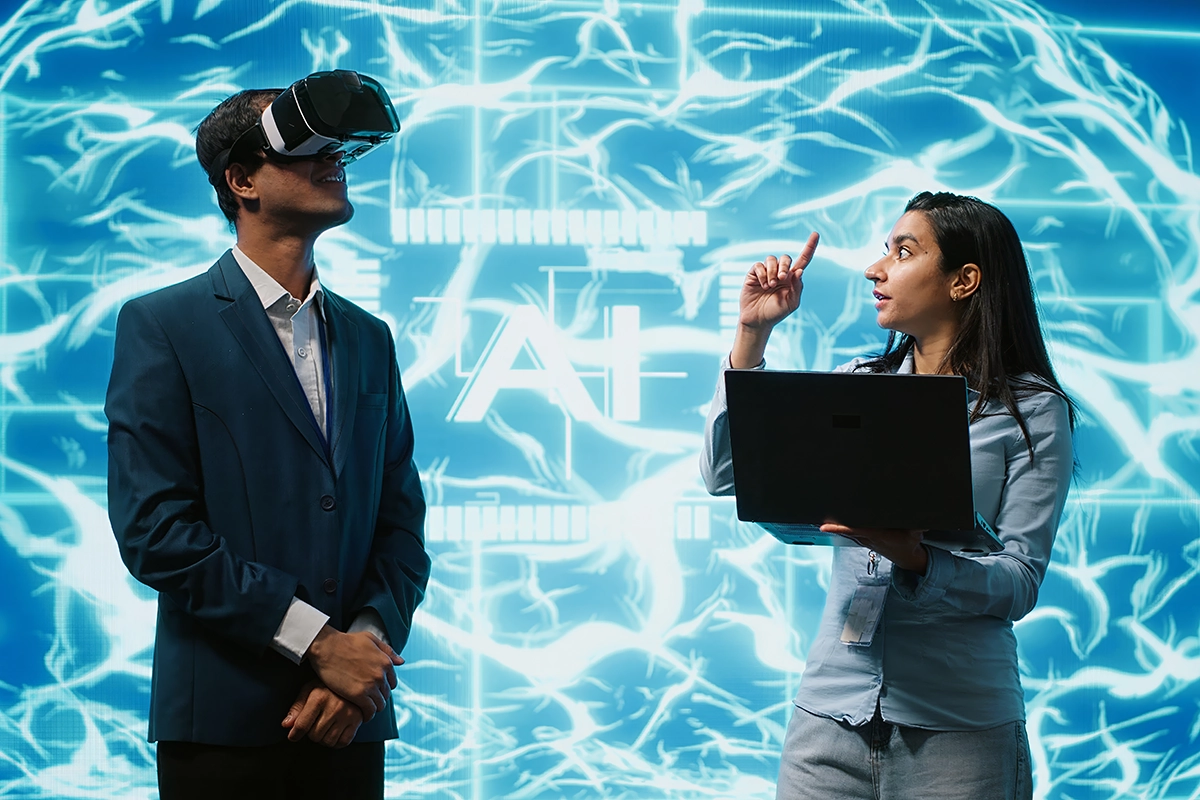
Over the past decade, two technologies have evolved in parallel, transforming the way we interact with the digital world: artificial intelligence (AI) and immersive reality technologies, such as augmented reality (AR) and virtual reality (VR). While each individually represents a significant advancement, their convergence is marking the beginning of a new era of hyper-personalized, intelligent, and deeply immersive digital experiences.
A New Technological Paradigm
The combination of AI with AR/VR not only redefines human-machine interaction but also enables systems that understand, anticipate, and respond to human behavior in real-time. While AR and VR provide immersive environments, AI acts as a cognitive engine, analyzing data, learning from users, and adapting content based on context.
For example, a virtual assistant in VR can interpret tone of voice, facial expressions, and user behavior to offer more human and appropriate responses. In AR, AI enables object recognition, real-time text translation, or providing contextual information directly over the user’s physical environment.
Key Opportunities
- Personalized Immersive Education
One of the most promising fields is education. The fusion of AI and VR allows for the creation of adaptive learning environments. A student can explore ancient Egypt in a 3D simulation while AI analyzes their learning pace, interests, and performance to dynamically modify the content. This not only improves knowledge retention but also increases student motivation. - Professional Training and SimulationIt is
In sectors such as medicine, aviation, or the military, training in safe but realistic environments is crucial. Thanks to AI, VR simulations can adapt to the user’s skill level, provide personalized feedback, and generate emergent scenarios that simulate unexpected situations, all in real-time. - Retail and Augmented Shopping Experiences
The combination of AR and AI enables consumers to visualize products in their environment before purchasing them, with intelligent recommendations based on their history, preferences, and behavior. Companies like IKEA or Sephora are already using these technologies to offer virtual furniture or makeup trials, significantly increasing conversion rates. - Mental Health and Wellbeing
VR-assisted therapy, reinforced with AI algorithms, has become a powerful tool for treating phobias, anxiety disorders, and post-traumatic stress. AI monitors patient physiological variables, such as heart rate or breathing patterns, and adapts the virtual environment to promote calmness or stimulate emotional coping.
Challenges to Overcome
Despite its enormous potential, the integration of AI with AR/VR presents technical, ethical, and social challenges that must be carefully considered:
- Data Privacy and Security
These technologies necessitate continuous collection of personal data, ranging from eye movements to facial expressions. Combining this with AI involves processing this information to learn and predict behaviors. This raises significant concerns regarding data privacy and the ethical use of data. - Costs and Accessibility
The creation of immersive, intelligent experiences remains costly due to hardware requirements, software development, and training. Democratizing these technologies requires reducing economic and technical barriers, particularly in regions or sectors with limited resources. - Accuracy in Human Interpretation
Despite advancements in AI models, limitations persist in their ability to understand complex human emotions or ambiguous situations. This can lead to unnatural interactions or even errors with potentially negative consequences, especially in sensitive contexts such as mental health. - Risk of Disconnection from Reality
Excessive or poorly designed use of immersive virtual environments can contribute to social isolation or dissociation, particularly among vulnerable populations. Responsible integration of AI should include safeguards to maintain balance between virtuality and real-life engagement.
Leading Case Studies
Several projects are already demonstrating the true potential of this synergy:
- Strivr: This platform combines VR and AI to deliver immersive corporate training to employees of companies like Walmart and Verizon. AI analyzes user behavior to identify areas for improvement and predict future performance.
- Google Lens + ARCore: Leveraging AI-powered visual recognition, users can translate, identify objects, or access information directly within their environment through their mobile device's camera, with increasingly sophisticated AR capabilities.
- Psious: A startup utilizing VR and artificial intelligence for psychological therapies. The system adapts exposure to stimuli based on the patient's physiological response, enhancing treatment efficacy compared to traditional methods.
Looking Ahead
As new brain-computer interfaces, more precise biometric sensors, and advanced AI algorithms develop, immersive intelligent experiences will evolve towards levels of realism and personalization previously unseen. This will transform industries and fundamentally alter how we communicate, learn, work, and heal.
The challenge lies not solely in building the technology, but in doing so inclusively, ethically, and with a human-centered approach. The convergence of immersive reality and artificial intelligence has the potential to revolutionize the digital world, provided we remember that, at the heart of this revolution, remains the human experience.