
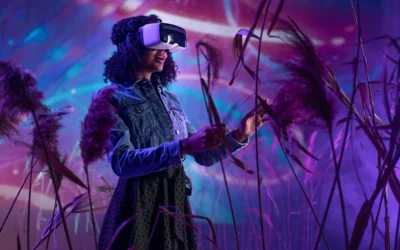
The Metaverse is a prominent term within the virtual sector. Statements from Mark Zuckerberg regarding future technology often trigger significant shifts within the industry. Following the announcement that Facebook intends to hire 10,000 employees from across the European Union over the next five years to develop a new platform – envisioned as the next major evolution following the internet: the Metaverse – there has been considerable market reaction.
This raises the question: what exactly is the Metaverse and why are companies like Facebook, Nvidia, and Microsoft making substantial investments in this technology?
Let's begin by clarifying the definition of this term. ‘Metaverse’ derives from ‘meta’ (beyond) and ‘universe.’ It refers to a parallel digital space to the physical world, where individuals can interact as avatars. The concept isn't new; it was originally coined in Neal Stephenson’s 1992 science fiction novel, ‘Snow Crash.’
In this novel, individuals are represented by avatars capable of interacting with one another. The narrative describes a completely new world where social norms and value systems are rewritten, and individuals are liberated from cultural and economic rigidity. This concept was later reimagined as the ‘OASIS’ in Ernest Klein’s novel ‘Ready Player One,’ which was adapted into a film by Steven Spielberg and centers around the idea of a parallel virtual world to the external real world, where people conduct much of their daily activities for entertainment or to escape a declining reality.
Technically, the term Metaverse refers to the convergence of physical, augmented, and virtual realities within a shared online space. It represents an evolution of the internet as we know it, creating a virtual universe that expands the physical world with a digital counterpart. While sharing similarities with video games, this replica of reality is designed for more than just gaming; it also aims to replicate many aspects of our daily social and economic activities. Users could participate in meetings, shop, manage banking transactions, attend concerts, or even work. The potential of this new parallel and digital world is as expansive as real life, or even greater.
"Within five years, people will think of us as a metaverse company, more than a social network."
(Mark Zuckerberg)
Within the Metaverse, key concepts include interactivity, immersion, and collaboration, collectively representing an alternative to the physical world.
Accessing this universe will require the use of virtual or mixed reality devices, enabling natural interaction within experiences. A critical element is interoperability – the ability for platforms from different companies and creators to connect, allowing users to seamlessly transition between them, similar to navigating attractions in a theme park or switching between websites using a browser.
THE HISTORY OF THE METAVERSE
Several precursors to this concept can be found within the network, with Fortnite, the massive online social game, standing out as a key success case. In April 2020, during the peak of the coronavirus pandemic, more than 12 million people attended a virtual concert by rapper Travis Scott.
Background also includes virtual worlds created by users on platforms like Minecraft and Roblox. And of course, Second Life, the innovative virtual community that, as early as 2003, implemented many of these ideas and which, 18 years later and partly thanks to the lockdown resulting from the pandemic, is now back in the spotlight.
THE POTENTIAL OF THE METAVERSE
According to Bloomberg, the Metaverse could represent a business opportunity of $800 billion by 2024.
As with the internet more than twenty years ago, which initially appeared to be a new paradigm for human communication and can also be an inexhaustible source of wealth for large technology companies, where the intangible gains enormous value.
This is because we must not forget that behind all this technical deployment are the data generated by users and the sale of advertising, the main revenue streams for companies like Facebook, whose vision of a virtual and immersive world could be very profitable for its shareholders.
One of the key decisions to be made in the near future is who will control the Metaverse.
Just as the internet is currently a decentralized technology, in which anyone can contribute – creating a website or offering cloud services, for example – it would be ideal for the Metaverse to be a free and open environment, not controlled by any individual or organization.
However, the usual technology players are already showing interest in it and aspire to, if not control it, play a significant role in its future. Microsoft, Google, Samsung and Sony, among many other companies, have joined Facebook with the purpose of creating the future of ‘experiential reality’, although they have done so under the Open XR standard, which seems to indicate a certain consensus in avoiding monopolies.
It is clear that we are on the cusp of a true revolution destined to change the way we interact with digital media in our daily lives.
Next stop? It appears that Zuckerberg plans to discuss the future of his company regarding the Metaverse at the Facebook Connect event on October 28th, so we will need to stay tuned for updates to learn more about what is to come.